








A Yard Sale Pricing Guide makes it much easier to price your stuff without standing in the driveway at 6 a.m. wondering whether that old lamp should be $3 or $15. The goal is not to squeeze the highest possible price out of every item, it is to choose prices that feel like a bargain to shoppers while still making the sale worthwhile for you.
I also love having most prices decided before the first shopper arrives. It makes your Yard Sale Set Up look organized, cuts down on constant “How much is this?” questions, and helps people make quick buying decisions. Clear prices can also encourage shoppers to pick up several things instead of cautiously asking about every item.
This guide covers practical starting prices, bundle deals, Yard Sale Signs Ideas, markdown strategies, and simple Yard Sale Tips And Tricks you can adjust for the condition and original value of your items. Think of it as a flexible Garage Sale Pricing Guide rather than a strict rulebook, because a nearly new coffee maker deserves a different price from the one that has been sitting in the garage since 2009.
Or check out our post 20 Garage Sale Ideas To Boost Sales
1. Start With the 10% to 30% Rule
If you have no idea where to start, price many everyday used items at around 10% to 30% of what they would cost new.
A $20 decorative cushion might start around $2 to $6, while a $40 kitchen appliance in good working condition might be around $8 to $12. Condition matters, so something barely used can sit toward the higher end while visibly worn items should be much cheaper.
This is especially handy when you are pricing lots of household items and need a quick system rather than researching every mug and mixing bowl individually.
Keep in mind that a yard sale is different from selling online. Buyers are expecting bargain prices because they are taking the item immediately, usually without returns, warranties, or much time to think about it.
For genuinely valuable, collectible, or nearly new items, check their current secondhand value separately rather than automatically using this rule.
Quick pricing examples:
$10 original price = around $1 to $3
$25 original price = around $3 to $7
$50 original price = around $5 to $15
$100 original price = around $10 to $30
2. Price Everyday Clothing Around $1 to $5
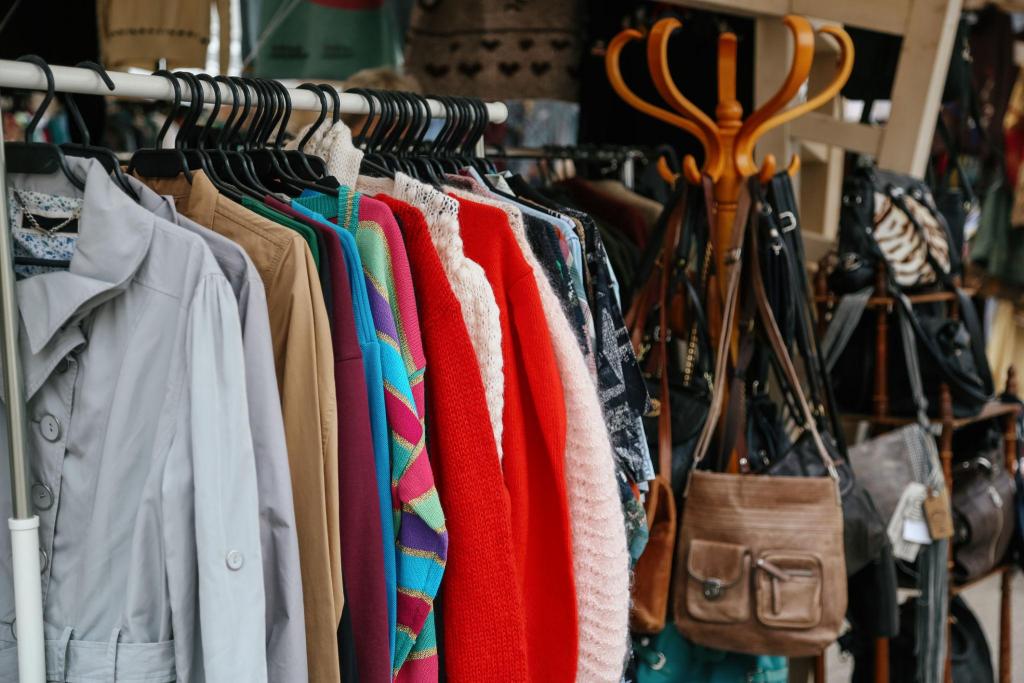
Clothes can quickly take over a yard sale, so I prefer simple category pricing instead of putting a different sticker on every T-shirt.
Basic tees, leggings, shorts, and everyday tops can often sit in the $1 to $3 range. Jeans, sweaters, dresses, and nicer pieces can start around $3 to $5 or more depending on condition and brand.
Clear category pricing makes a clothing rack much easier to shop. Put up a sign saying “T-Shirts $2, Jeans $5, Dresses $5” and shoppers immediately know what they are dealing with.
Save individual prices for premium pieces, coats, designer brands, new-with-tags clothing, and anything genuinely valuable.
You can also introduce bundle pricing later in the day, such as “Any 5 Clothing Items for $10.” That encourages shoppers to stop debating over one shirt and start filling their arms instead.
Easy clothing Yard Sale Pricing Guide starting point:
T-shirts: $1 to $3
Tops: $2 to $4
Jeans: $3 to $5
Dresses: $3 to $8
Jackets: $5 to $15
Coats: $8 to $25
3. Make Kids’ Clothes a Bundle Deal
Tiny clothes need tiny prices, especially when you have boxes of them to clear.
Instead of pricing every baby bodysuit at 50 cents, create bundle deals such as “5 Baby Items for $5” or “Fill a Bag for $10.” Parents can quickly look through sizes and build a bundle without doing mental arithmetic for every piece.
Sort clothing into clearly labeled tubs such as “0 to 3 Months,” “3 to 6 Months,” “Toddler,” and “Age 4 to 5.” Your pricing system then becomes part of your Yard Sale Set Up, making the whole section easier to navigate.
Save higher individual prices for coats, occasion outfits, branded clothing, unworn shoes, and nearly new pieces.
A big “BUILD A BUNDLE” sign above the section can also make an ordinary clothing table feel like a deal shoppers do not want to miss.
Try: 5 pieces for $5, 10 pieces for $8, or fill a small bag for $10 for your next Yard Sale Pricing Guide.
4. Keep Most Books Between 50 Cents and $2
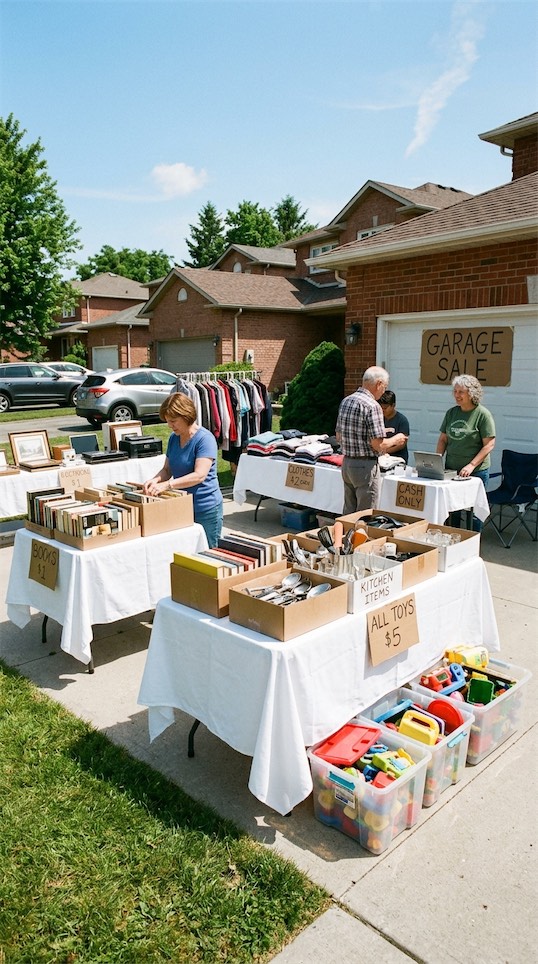
Books are perfect low-cost impulse buys, but high prices can leave you carrying heavy boxes back inside at the end of the day.
A simple Rummage Sale Pricing Guide for ordinary books might be 50 cents to $1 for children’s books and paperbacks, then $1 to $3 for hardbacks, cookbooks, coffee-table books, or newer titles.
Rather than individually labeling every spine, display one large price sign above the books.
Then add a bundle such as “5 Books for $4.” Someone who originally wanted one paperback suddenly has a reason to choose four more.
Keep collectible books, signed copies, box sets, recent textbooks, and valuable editions separate until you have checked their resale value.
Simple book sign:
Paperbacks $1
Hardbacks $2
Kids’ Books 50¢
Any 5 Books $4
5. Price Toys to Encourage Kids to Choose More Than One
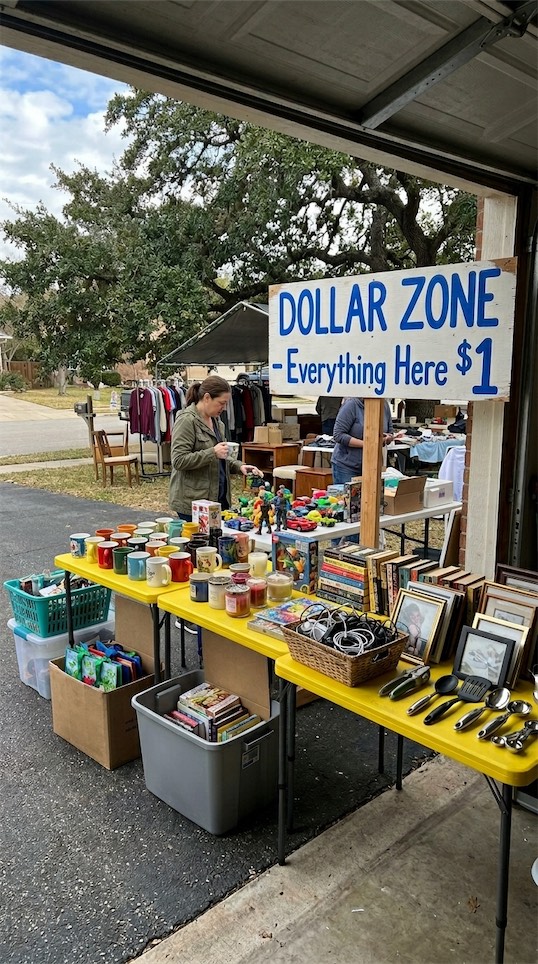
For ordinary used toys, think pocket-money prices for your Yard Sale Pricing Guide.
Small figures, cars, dolls, puzzles, and basic toys can often be priced from 50 cents to $3. Larger sets, electronic toys, ride-ons, and expensive branded items can be priced individually.
I would put small toys into shallow baskets labeled “$1 EACH” rather than attaching stickers to everything. Kids can rummage through the basket while parents immediately understand the price.
You can also create “3 for $2” or “5 for $4” deals when you have lots of small toys.
Check that puzzles and games have their important pieces before charging more for them. A sticky note saying “Complete Set, Checked” can make a higher price feel much more reasonable.
This is one of those Yard Sale Tips And Tricks that helps with two things at once, easier pricing for you and more items leaving the driveway.
6. Price Kitchenware in Simple Groups
Nobody wants to hunt for a microscopic sticker underneath every spoon and cereal bowl.
Group everyday kitchen items into easy price levels instead. You might have a $1 section for mugs and utensils, a $2 to $3 section for bowls and serving pieces, then individually priced cookware and appliances.
Matching sets can command more than miscellaneous pieces, so keep sets together wherever possible.
For example, six matching wine glasses might sell better as “Set of 6, $8” than six individually priced $2 glasses.
Use trays, baskets, or crates to separate each price level physically. Your table becomes easier to understand from several feet away.
Useful starting prices:
Mugs: 50¢ to $2
Glasses: 50¢ to $2 each
Serving bowls: $2 to $5
Pans: $3 to $10
Bakeware: $2 to $8
Complete dish sets: price individually
7. Charge More for Working Small Appliances
A toaster that shoppers know works is much easier to sell than a mysterious toaster sitting silently on a table.
Small appliances such as kettles, blenders, slow cookers, coffee makers, and sandwich presses can often start around 15% to 30% of their current new price, depending on age and condition.
Clean them thoroughly before the sale. Crumbs, grease, and dusty cords make even perfectly functional appliances feel less valuable.
Then attach a large label saying “TESTED, WORKS.”
If practical, have access to an outlet so serious shoppers can see electrical items working.
A clean $10 coffee maker labeled “Tested This Morning, Works Great” feels like a much safer purchase than an unlabeled one for $8 as part of your Yard Sale Pricing Guide.
8. Give Furniture Room to Have a Higher Price
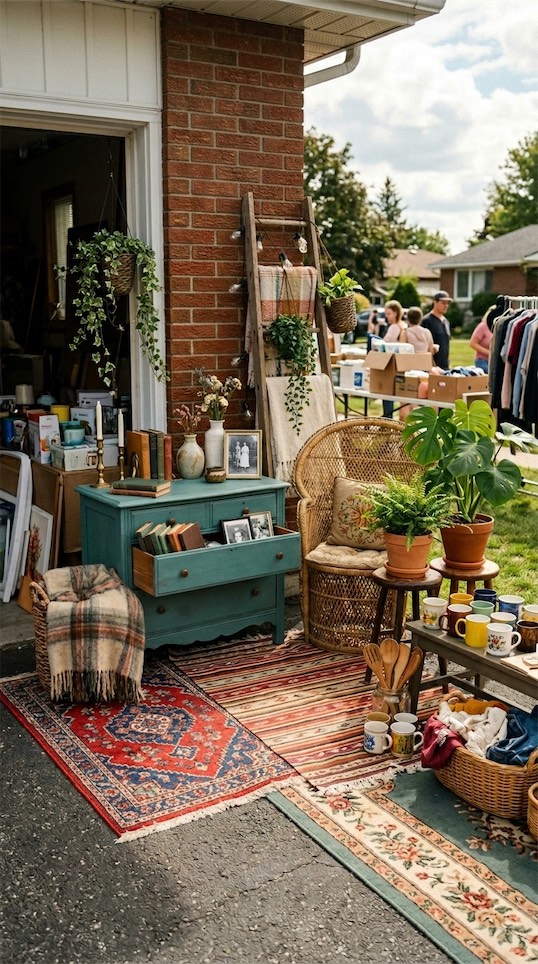
Do not automatically price a solid dresser like a $2 household item.
Furniture needs to be judged according to condition, quality, material, brand, and current secondhand demand. A basic flat-pack side table may only warrant $5 to $15, while solid wood furniture could reasonably be much higher.
Clean furniture and display it as though it belongs in a room. Put a lamp on the side table or a cushion on the chair rather than leaving everything in a random pile.
Include measurements on the price card too. Shoppers can immediately check whether that bookshelf will actually fit their space.
If an item has damage, mention it. “$20, small scratch on side” creates more confidence than hoping nobody notices.
Leave a little negotiating room on higher-ticket pieces if you are comfortable accepting offers.
9. Use Round Numbers Instead of Complicated Prices
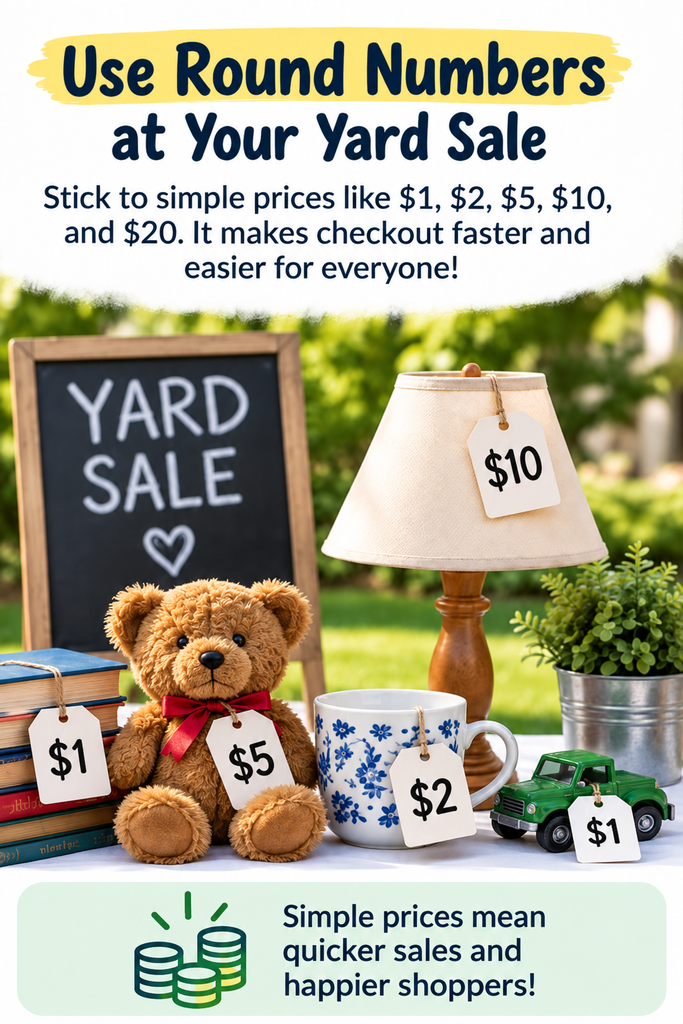
A yard sale does not need $3.79 pricing.
Simple prices such as $1, $2, $5, $10, and $20 make transactions quicker and reduce the amount of change you need.
Round pricing also makes bundle calculations easier. If three items are $2 each, both you and the shopper immediately know the starting total is $6.
For cheaper products, 25-cent and 50-cent increments are still useful, particularly for children’s books, craft supplies, and tiny toys.
Avoid creating dozens of strange price points unless there is a reason for them.
A simple Garage Sale Pricing Guide should make your morning easier, not turn checkout into an accounting exercise.
10. Color-Code Your Price Stickers
If several people are selling at the same yard sale, colored stickers are brilliant.
Give each seller a different color. Your items might have pink stickers, your sister’s blue, and your neighbor’s yellow.
Keep a small notebook at checkout and record each sale by color.
You can also use colors as price categories. For example, green could mean $1, yellow $2, pink $5, and blue $10.
If you choose this method, display the color key prominently in several places. Never make shoppers guess what a sticker means.
It is one of my favorite practical Yard Sale Signs Ideas because one simple poster can replace hundreds of individually written price tags.
Example sign:
GREEN = $1
YELLOW = $2
PINK = $5
BLUE = $10
11. Create $1, $3, and $5 Tables
Sometimes the easiest price tag is the table itself.
Create clearly separated $1, $3, and $5 tables and place items directly into the appropriate section. This is fantastic for decor, kitchenware, toys, accessories, craft supplies, and miscellaneous household pieces.
Huge price signs let people understand the deal while they are still approaching.
It also creates a natural shopping progression. Someone may start digging through the $1 table and then wander toward the $3 and $5 sections.
Keep the tables genuinely separate so products do not migrate between prices as people browse.
If you have a lot of inexpensive inventory, make the $1 table closest to the sidewalk. A giant “EVERYTHING $1” sign is much more tempting from the road than dozens of tiny stickers.
12. Make a 50-Cent Basket for Tiny Items
Those awkward little items still deserve a spot in your Yard Sale Pricing Guide.
Pens, magnets, keychains, small craft supplies, costume jewelry, toy cars, cookie cutters, and other tiny objects can go into a clearly marked 50-cent basket.
The low price encourages impulse buying, particularly while someone else in the family is still browsing.
Place the basket near checkout so shoppers see it before paying.
You can also add “3 for $1” if your main goal is clearing as much as possible.
It is basically the yard sale version of the little treats beside a store register. Nobody arrived looking for a novelty fridge magnet, but for 50 cents, suddenly it seems like a perfectly sensible purchase.
13. Bundle Similar Items Instead of Pricing Everything Separately In Your Yard Sale Pricing Guide
If you have six related things, try selling the collection rather than six individual items.
Craft supplies could become a $5 craft bundle. Five plant pots might become a $6 gardening bundle. A stack of children’s DVDs could become a $5 movie-night bundle.
Bundles increase the number of items leaving your house while giving shoppers an obvious deal.
Clear bags, baskets, or boxes are useful for keeping each bundle together.
Write the individual value and bundle price on the sign if it strengthens the offer, such as “$2 Each or 4 for $6.”
The discount should be easy to understand immediately. Complicated offers slow people down rather than encouraging them to spend.
14. Put Higher Prices on Items With Tags or Original Packaging
Unused items should not automatically be priced like heavily used ones.
If something still has its original tag, box, seal, or packaging, make that visible when you display it. Shoppers can immediately see why it costs more than similar secondhand products nearby.
Depending on the item and demand, you might start around 30% to 50% of the current retail price rather than using your normal bargain pricing.
Do check what the item currently costs new. An old $60 sticker does not mean much if the same product now sells for $25.
Write “NEW,” “UNOPENED,” or “WITH TAGS” prominently on the price card.
That tiny detail helps explain the price before shoppers even think about negotiating.
15. Research Collectibles Before Pricing Them As Part Of Your Yard Sale Pricing Guide
Do not accidentally sell the one valuable item on your driveway for $2.
Before the sale, quickly research anything that looks collectible or unusually old. Think vintage toys, trading cards, vinyl records, coins, discontinued decor, certain Pyrex patterns, designer pieces, old cameras, and collectible Christmas decorations.
Look at recent sold prices where possible, not just optimistic asking prices.
If something appears genuinely valuable, you may decide that a yard sale is not the best place to sell it at all.
For moderately collectible items you still want to include, price them separately and keep them near your checkout area.
Your everyday Yard Sale Pricing Guide can cover most belongings, but unusual items deserve a few extra minutes of research.
16. Leave Room to Negotiate on Expensive Items
Haggling is part of the fun for plenty of yard sale shoppers.
If you want $40 for a piece of furniture, you might price it slightly higher if you are comfortable negotiating down. The key is knowing your minimum before the sale starts.
You do not need negotiating room on everything. Haggling over a 50-cent spoon gets old very quickly.
For higher-priced items, signs such as “Reasonable Offers Welcome” can encourage hesitant shoppers to start a conversation.
If you absolutely do not want to negotiate on something, mark it “Firm.”
Having those boundaries decided in advance prevents that awkward moment where someone offers $5 for your $30 item and you suddenly forget what you were willing to accept.
17. Use “2 for” and “3 for” Pricing to Increase Sales In Your Yard Sale Pricing Guide
One item for $2 is fine. Three for $5 suddenly feels like a deal.
Multi-buy pricing is particularly effective when you have lots of similar lower-priced items. Books, clothing, DVDs, toys, plant pots, candles, and kitchenware are all good candidates.
Make the saving noticeable enough to motivate shoppers without cutting the price dramatically.
For example:
$2 each or 3 for $5
Someone interested in one item now has a reason to hunt for another two.
Keep qualifying products together so the offer is obvious. Scattering them across several tables makes the deal harder to use.
This is a simple pricing trick, but it can noticeably increase how many items each customer carries to checkout.
18. Add a “Make Me an Offer” Section
Some things are simply annoying to price.
Instead of wasting twenty minutes deciding whether an odd vase is worth $2 or $4, create a small “Make Me an Offer” section.
Use this for unusual items, leftovers, bulky pieces, or things you mainly want gone.
I would not use it across the entire yard sale. Many shoppers prefer knowing the price without having to start a negotiation.
A dedicated section makes it feel intentional and fun instead.
Try a sign such as “MAKE ME AN OFFER, I MIGHT SAY YES.”
That little bit of humor can also become one of your most memorable Yard Sale Signs Ideas, encouraging shoppers to interact instead of silently walking past.
19. Schedule a Midday Markdown
Do not wait until the final five minutes to start reducing prices.
Decide beforehand when your first markdown will happen. If the sale runs from 8 a.m. until 2 p.m., you might keep normal prices until 11:30 or noon, then reduce selected categories.
Use one big sign rather than changing hundreds of stickers.
For example:
AFTER 12 PM, CLOTHING 50% OFF
or
$1 TABLE NOW 2 ITEMS FOR $1
This gives you the morning to sell to early shoppers at your preferred prices while helping clear inventory once traffic starts slowing.
It also makes your Yard Sale Set Up feel active throughout the day instead of slowly becoming a collection of leftovers.
20. Finish With a Final-Hour “Fill a Bag” Sale
When you are tired, sunburned, and absolutely do not want to carry everything back into the garage, bring out the bags.
A final-hour fill-a-bag sale can clear huge amounts of low-value inventory quickly. Give shoppers a standard grocery or paper bag and charge a fixed amount for everything they can reasonably fit inside.
You might try $5 for books and small household goods or $10 for clothing, depending on what remains.
Exclude expensive items and clearly mark what qualifies before starting.
Then put a large sign near the road saying FINAL HOUR, FILL A BAG FOR $5.
People who already visited earlier may even come back when they see the new offer.
It is one of my favorite end-of-day Yard Sale Tips And Tricks because the final goal changes. You have already made your sales, now you want fewer boxes going back inside.
21. Add a $1 Lucky Dip Basket
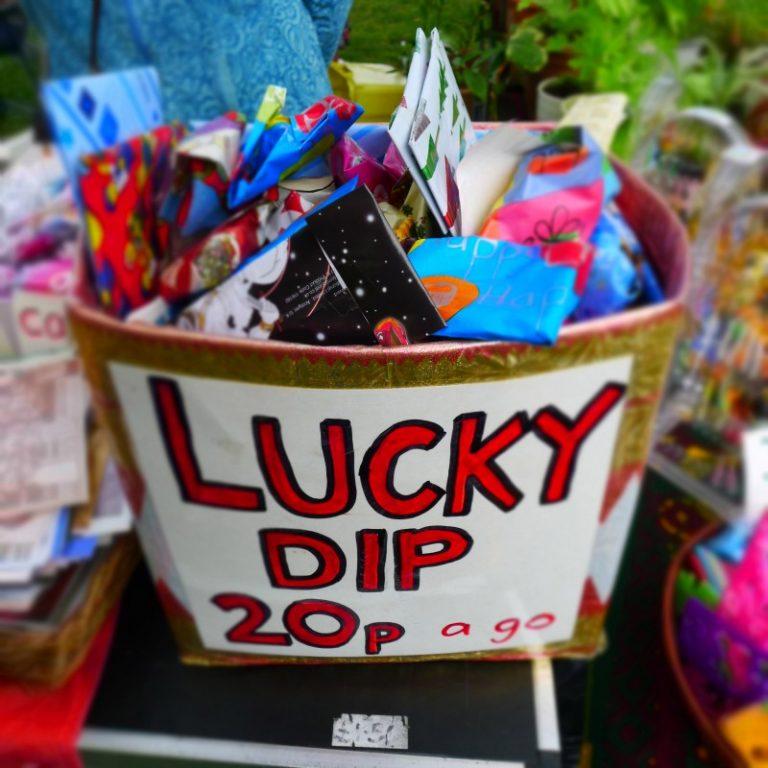
Turn all those tiny, awkward-to-price items into a $1 Lucky Dip and you might be surprised how quickly they disappear.
Wrap small items in tissue paper, paper bags, or leftover gift wrap, then place them in a colorful basket with a big sign saying “$1 Lucky Dip, Every Bag Has a Surprise!” The mystery makes a one-dollar purchase feel much more exciting than simply putting the same items on a clearance table.
Fill the bags with things you would otherwise struggle to sell individually, such as small toys, unopened stationery, costume jewelry, stickers, keychains, craft supplies, mini beauty products, or little novelty items. Just make sure every bag contains something genuinely worth the $1 price so nobody feels disappointed.
You could also create different colored lucky dips, such as Kids $1, Beauty $2, and Mystery Home Finds $3. That lets you use the same idea for different types and values of leftover stock.
Place the basket close to your checkout table where children and adults will spot it while someone is paying. It becomes an easy last-minute add-on, almost like the impulse-buy section beside a store register.
This is one of those Yard Sale Tips And Tricks that is especially useful later in the day. You are clearing several hard-to-price odds and ends while shoppers get the fun of wondering what they will unwrap.
Yard Sale Signs Ideas:
“$1 LUCKY DIP, PICK A BAG!”
“EVERY BAG IS A WINNER”
“NO PEEKING, JUST PICKING!”
“MYSTERY FINDS, $1 EACH”