








Finding the right support for a climbing rose can make the difference between a plant that looks messy and one that covers a wall, fence or garden corner with flowers. These climbing rose trellis ideas include simple DIY supports, wooden panels, wire systems, arches, pergolas and freestanding options that work in both large and small gardens.
There are also plenty of practical choices if you are searching for cheap trellis ideas, want to grow climbing roses on a house, need support for climbing roses in pots, or want easy rose trellis ideas DIY projects you can tackle without advanced woodworking skills. The key is choosing a trellis that suits where the rose is growing and will still be strong enough once the plant becomes larger and heavier.
1. Make a Simple Wire Trellis Against the House
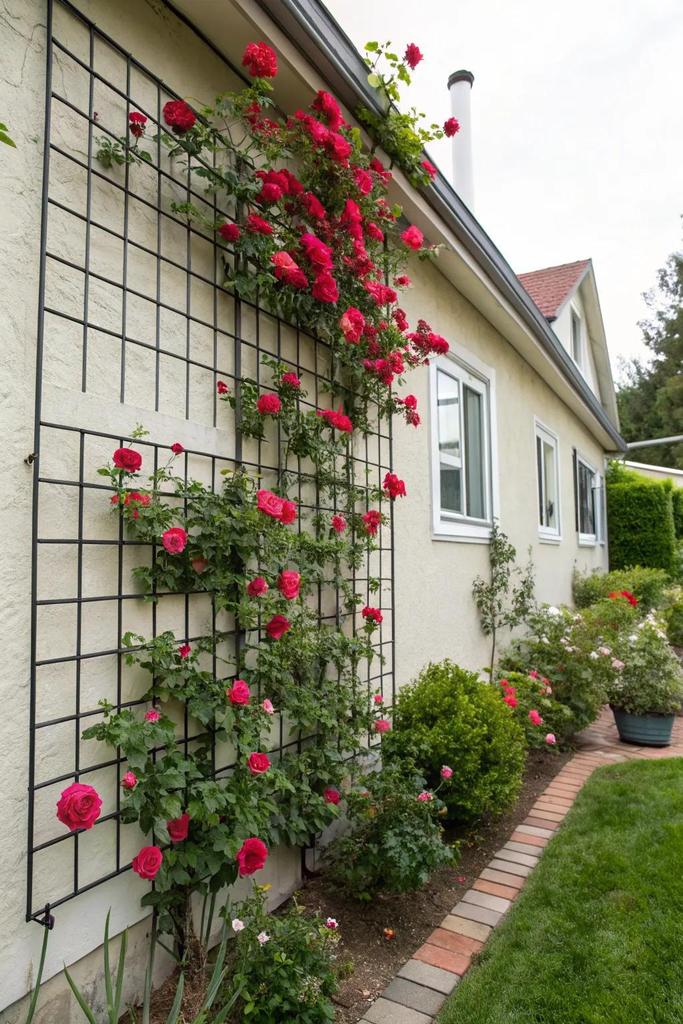
A wire trellis is one of the easiest ways to grow a climbing rose against a blank exterior wall without covering the house with bulky wooden panels.
This works especially well if you love the look of climbing roses on house walls but want most of the support to disappear once the plant fills out. Horizontal wires give you places to tie the main rose canes so you can spread them across the wall instead of letting everything grow straight upward.
You can make one using vine eyes, suitable wall fixings and strong galvanized or stainless steel garden wire. Run several horizontal rows across the area you want the rose to cover, leaving enough room between the plant and wall for air to move around it.
This is also one of the cleaner trellis ideas DIY climbing vines gardeners can adapt for roses, clematis and other climbers.
Put it beside a sunny wall, garage or side of the house where you have a large empty surface that could use flowers.
2. Cover a Blank Wall With a Wooden Lattice Trellis
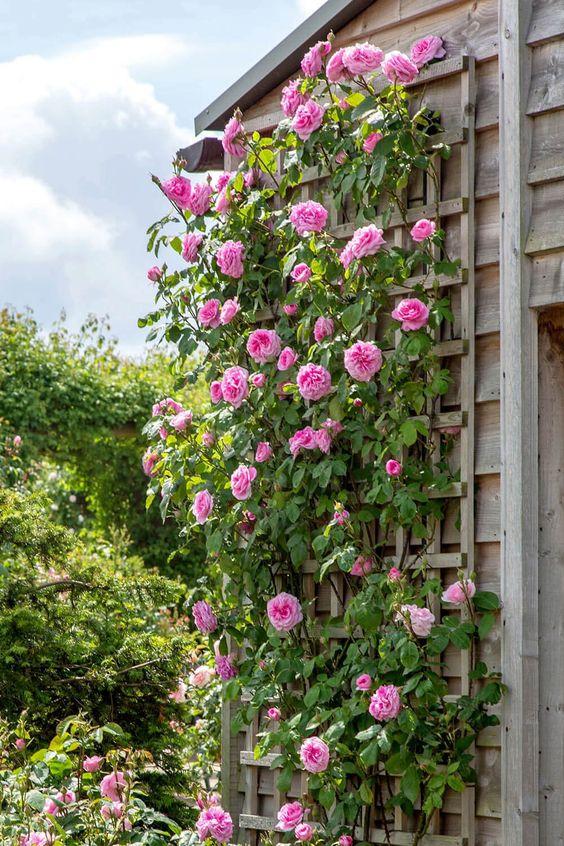
If a large exterior wall looks bare, a wooden lattice panel gives a climbing rose an obvious structure to grow across.
This is a good choice for homeowners who want something easier than installing individual wires. You can buy ready-made timber lattice panels, attach them securely to battens and train the rose across the open sections.
Paint or stain the wood before installing it so you are not trying to work behind thorny rose stems later. White lattice works well with cottage-style gardens, while natural or stained timber blends easily with fences, sheds and raised beds.
The main mistake to avoid is fixing the lattice completely flat against the wall. Leave a small gap behind it so you can tie stems easily and air can move around the plant.
Use this idea on a garage wall, shed, side return or blank section of the house where a large rose can spread comfortably.
3. Train a Climbing Rose Over a Small Front Porch
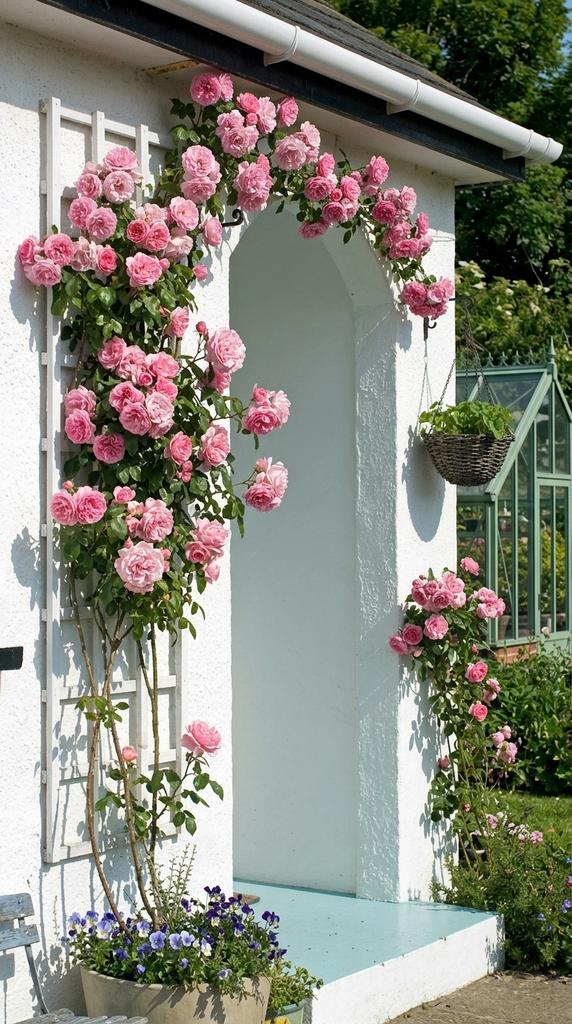
A climbing rose can turn a plain front porch into one of the most noticeable parts of the house without adding lots of pots and decorations.
The idea works particularly well when you have a small entrance that feels unfinished. Instead of filling the porch floor with containers, train the rose upward beside the doorway and then across a wire or trellis support above the porch.
Start with sturdy wire or narrow trellis panels on each side of the entrance. As the rose grows, tie the main canes gently into position rather than expecting them to cling to the wall by themselves.
You do not need a huge porch for this. Even a narrow front entrance can work if there is planting space beside it.
Keep stems away from gutters, windows and areas that need regular maintenance. The goal is to frame the entrance, not make it difficult to open windows or clean the porch.
4. Frame a Doorway With Climbing Roses
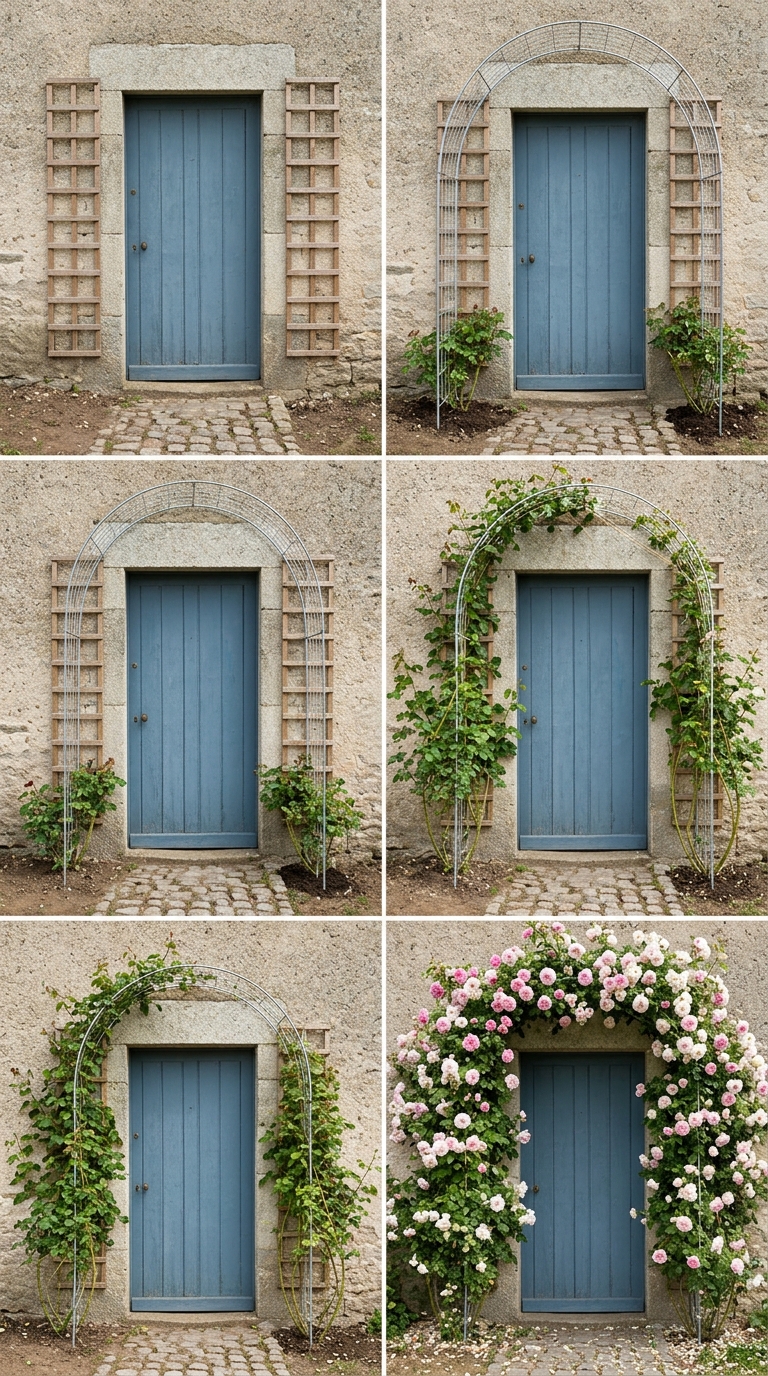
If covering an entire house wall feels like too much maintenance, growing roses around one doorway gives you the same cottage-garden feel on a smaller scale.
This solves the problem of an entrance that looks plain without requiring a large trellis installation. Add narrow supports on either side of the door, then connect them above the entrance using strong wire or a simple arch-shaped frame.
Train one rose from each side if you want faster coverage, or use one vigorous climber and gradually guide the canes around the doorway.
Keep the stems tied back so thorns do not catch coats, bags or anyone walking through the door. It is also worth leaving enough clear space around door lights, house numbers and locks.
This idea works particularly well around garden gates, side entrances and front doors where the rose can be noticed every time someone approaches the house.
5. Train Climbing Roses Along a Fence
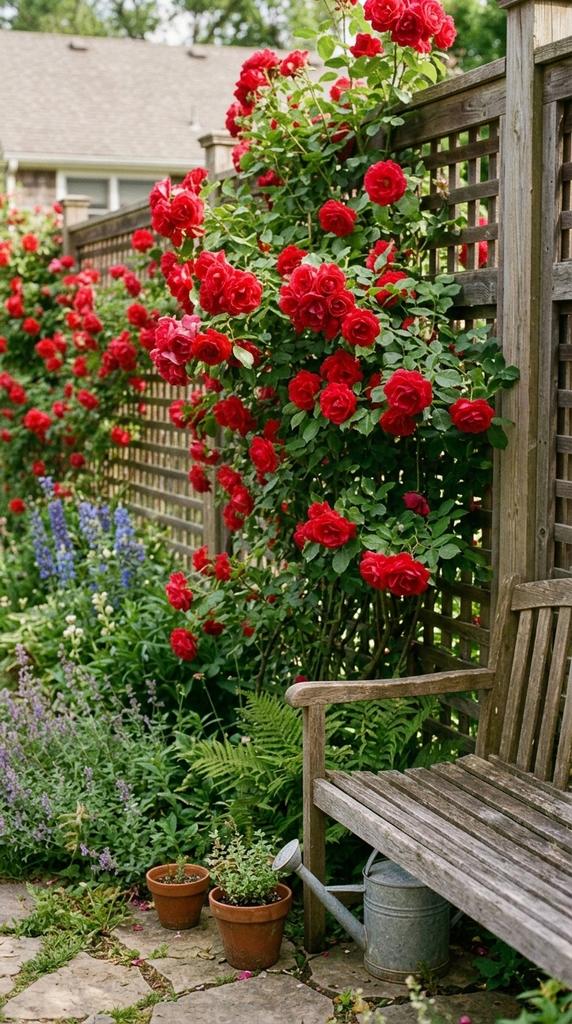
A long fence gives a climbing rose plenty of room to spread, making this one of the most practical ways to get a large wall of flowers without building a separate garden structure.
For climbing roses fence ideas, the main thing to remember is that roses need help staying attached. They do not cling to fencing by themselves, so add horizontal wires, lattice or a separate trellis panel and tie the stems onto it as they grow.
This is especially useful if the fence looks plain, weathered or too dominant in the garden. Once the rose fills out, the flowers break up a long stretch of timber or metal.
For a cheaper setup, attach several rows of garden wire across sturdy fence posts rather than buying decorative trellis panels.
Place the rose where it receives enough sun and where you can still reach the stems for tying and pruning.
6. Add Trellis Panels to an Ugly Fence
If your fence needs hiding but is not suitable for attaching wires directly, place separate trellis panels just in front of it.
This gives the rose its own support and means you are not relying on old or weak fencing to hold a mature plant. It can also make future fence repairs easier because the rose is attached to the trellis rather than woven through every fence board.
Ready-made wooden panels are the easiest option. Secure them to posts with a small gap behind them, then plant the rose near the base and guide the stems horizontally as they get longer.
For a budget version, use simple rectangular garden trellis rather than expensive decorative panels. Once the rose covers most of it, very little of the structure will be visible anyway.
This works well along boundaries, beside sheds and anywhere an unattractive fence is one of the first things you notice from the patio or kitchen window.
7. Use a Rose Trellis as a Privacy Screen
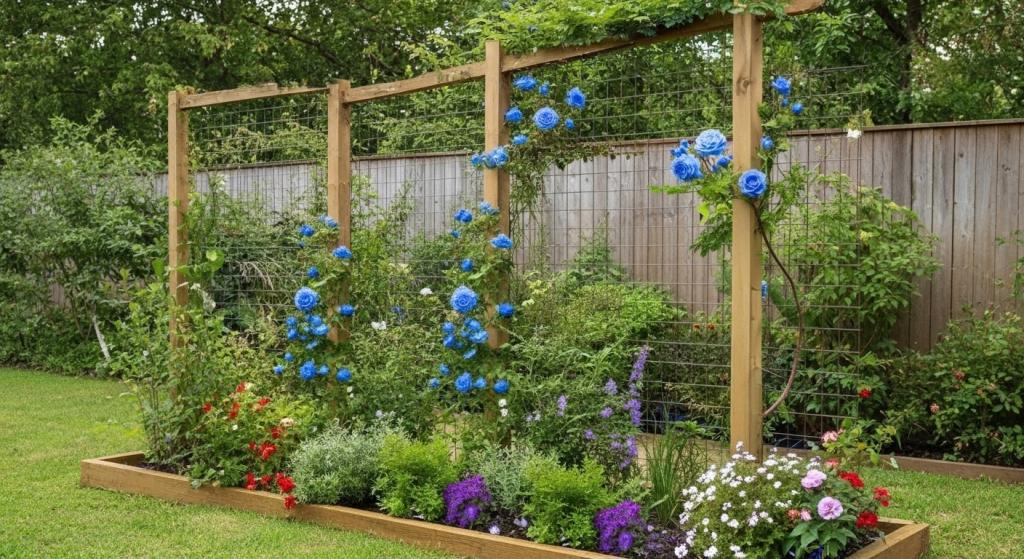
A climbing rose trellis can help screen a patio, seating area or overlooked part of the garden without building a solid wall. They make pretty and functional privacy trellis ideas.
The best setup is a strong freestanding trellis or screen positioned where you actually need coverage. Plant the rose beside it and train the canes across the support so flowers and leaves gradually fill the gaps.
This is useful beside a patio where a neighbour’s window overlooks the seating area, around a hot tub, beside a garden bench or along a boundary where you want something softer than another fence.
You can save money by using basic timber posts and square trellis panels rather than buying a decorative privacy screen.
Do remember that roses lose some leaves during colder months, so this works better for seasonal screening than year-round privacy.
For more complete coverage, combine the rose with another suitable climber rather than expecting one young plant to hide everything immediately.
8. Build a Cheap Rebar Rose Trellis
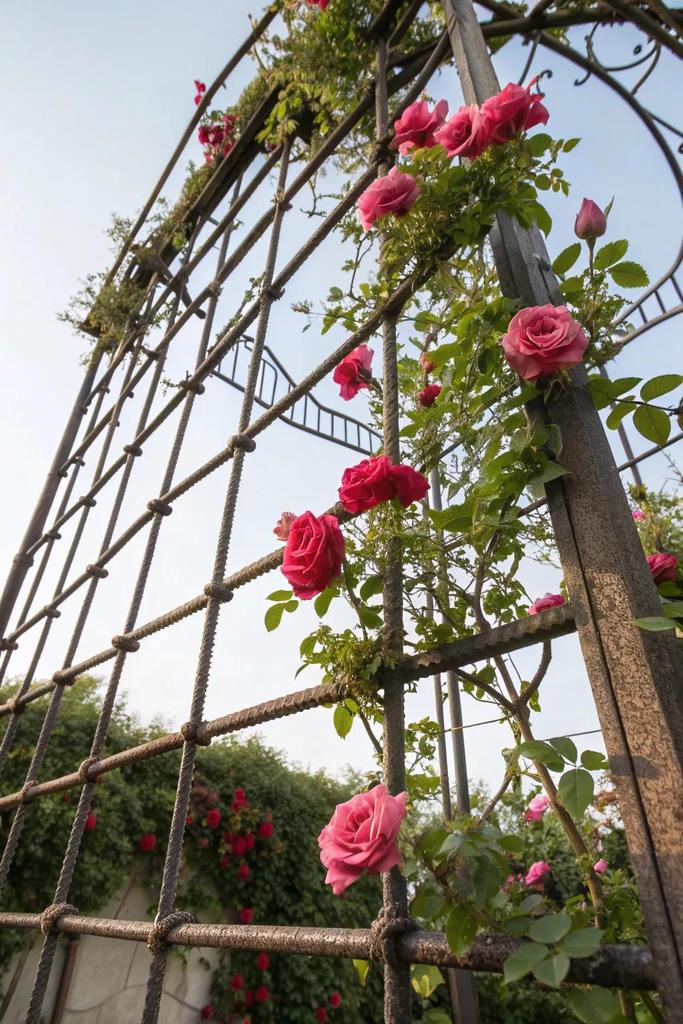
If you are looking for cheap trellis ideas, rebar can make a surprisingly simple support for climbing roses.
This is useful when you need something strong but do not want to spend much on a decorative metal structure. Rebar is particularly good for informal gardens because the dark metal tends to disappear once stems and leaves cover it.
One simple version uses two or more vertical lengths pushed or fixed securely into the ground, with horizontal pieces wired between them. You can also bend suitable lengths into an arch if you have the tools and experience to do it safely.
Keep the shape simple. A basic grid is easier to build and gives you plenty of places to tie rose canes.
Use it at the back of a flower bed, against a fence or beside a vegetable garden where a very decorative trellis would look unnecessary.
Make sure the finished structure is stable before adding the plant because mature climbing roses can become surprisingly heavy.
9. Make a Basic Wooden DIY Rose Trellis
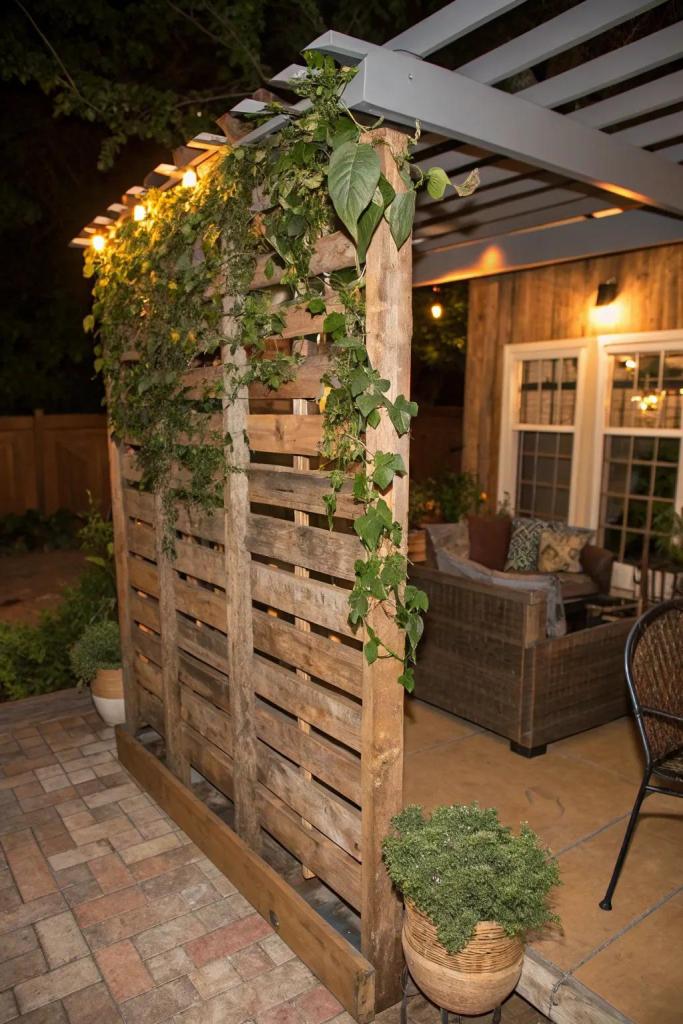
A simple timber frame is one of the most approachable rose trellis ideas DIY projects because you can adjust the size to fit the exact space you have.
Build a rectangular outer frame from outdoor-treated timber or pallets then add narrow horizontal and vertical strips to form a basic grid. You do not need complicated curves or decorative cuts for it to look good once the rose begins covering it.
Paint, stain or seal the timber before attaching it. Secure it firmly to posts or stand it slightly away from a wall so there is room to tie the rose.
A homemade wooden trellis works beside patios, against sheds, at the back of flower beds and along fences.
For the cheapest version, keep the frame rectangular and spend your money on strong fixings rather than decorative woodwork.
10. Choose a Metal Wall Trellis for a Neater Finish
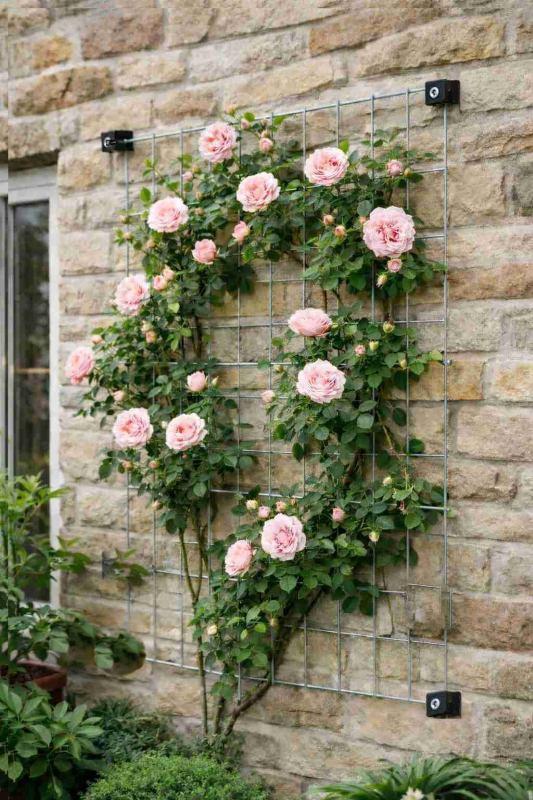
A metal trellis is useful when you want a permanent support that looks tidy even before the rose has covered it.
It works particularly well on visible walls near patios, front entrances or seating areas where a basic wooden panel might look too heavy.
Choose a tall metal grid or decorative wall trellis that gives the stems several horizontal points where they can be tied. Black and dark metal supports often become much less noticeable once foliage grows through them.
You can buy one large panel or place two narrow panels side by side if you want the rose to spread across a wider section of wall.
Check how the trellis is fixed before buying. A mature climbing rose can put a lot of weight onto the structure, especially after rain, so lightweight decorative hooks are not enough.
This is usually more expensive than wire, but it requires very little building and can last for years.
11. Build a Rose Arch Over a Garden Path
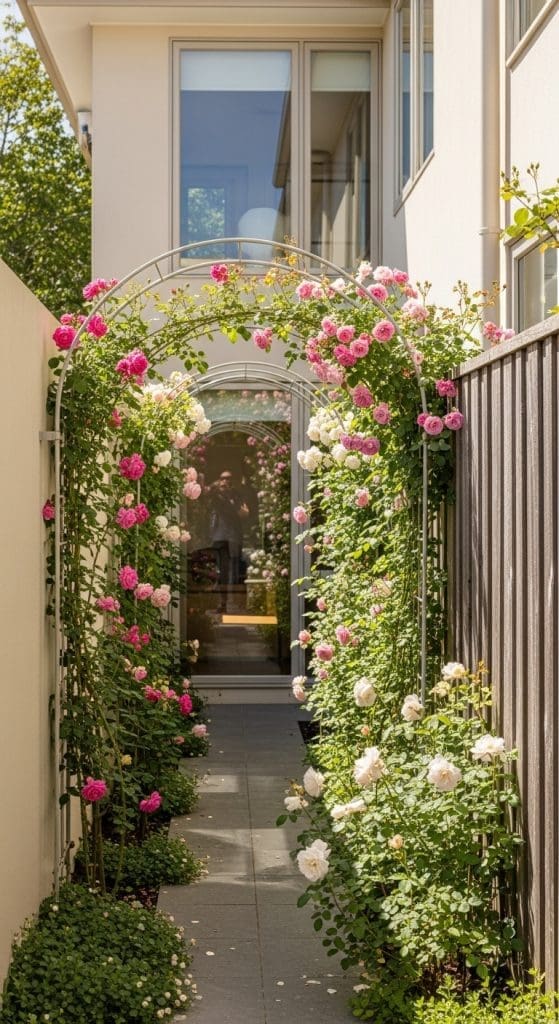
A rose arch makes sense when you want the trellis to mark a path or entrance rather than simply cover a wall.
Place the arch where people naturally walk, such as between the patio and lawn, at the entrance to a vegetable garden or where one section of the garden leads into another.
For a DIY version, build a simple wooden arch from posts and crosspieces or buy a basic metal arch and secure it properly into the ground.
Plant a climbing rose on one side or one on each side for fuller coverage. Tie stems around and across the structure as they lengthen rather than allowing them to grow straight upward.
Make sure the opening is wide enough for people to walk through comfortably once stems begin hanging over the sides.
A common mistake is buying a very lightweight arch for a vigorous rose. Choose a structure strong enough to hold mature stems and wet foliage without leaning.
12. Put a Rose Arbor at the Garden Entrance
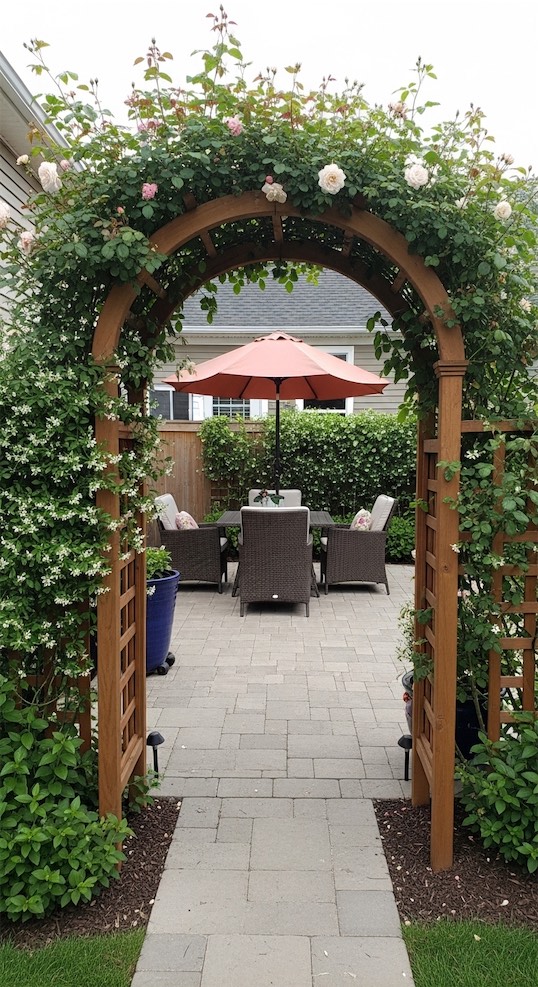
A rose arbor works well when you want a wider and more substantial version of a basic garden arch.
This is particularly useful at the entrance to a back garden, between two garden areas or at the beginning of a path. Because an arbor usually has deeper side panels, it gives climbing roses more support than a narrow arch.
You can buy a wooden arbor kit or build a simple version from four sturdy posts, side lattice panels and crossbeams across the top.
If the budget is limited, skip built-in benches and complicated decorative details. The roses will become the main feature once they cover the structure.
Plant one rose beside each side panel and tie the stems outward as well as upward. That encourages flowers across the sides instead of leaving all the blooms near the top.
Keep the opening clear enough for wheelbarrows, bins or garden equipment if this is a route you use regularly.
13. Train Climbing Roses Over a Pergola
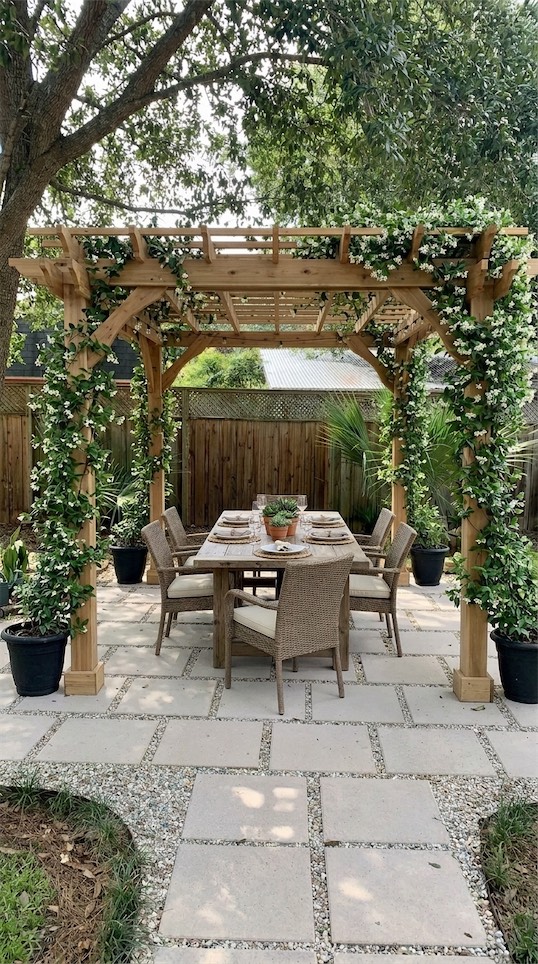
A pergola is one of the best supports for a vigorous climbing rose because it gives long canes plenty of space to spread.
This idea works when a patio or seating area feels exposed and you want planting overhead as well as around the sides.
Plant roses beside the pergola posts and tie the main stems upward. Once they reach the top, start training them along the horizontal beams rather than allowing every cane to continue growing vertically.
You do not need to cover the whole pergola with roses. One or two plants positioned near the most visible posts can be enough to soften a large timber structure.
If you are building the pergola specifically for roses, use strong posts and beams from the start. Replacing a weak structure becomes much harder once mature thorny plants are wrapped around it.
This is one of the most useful rose trellis ideas for larger patios, garden seating areas and paths.
14. Use a Freestanding Trellis in a Flower Bed
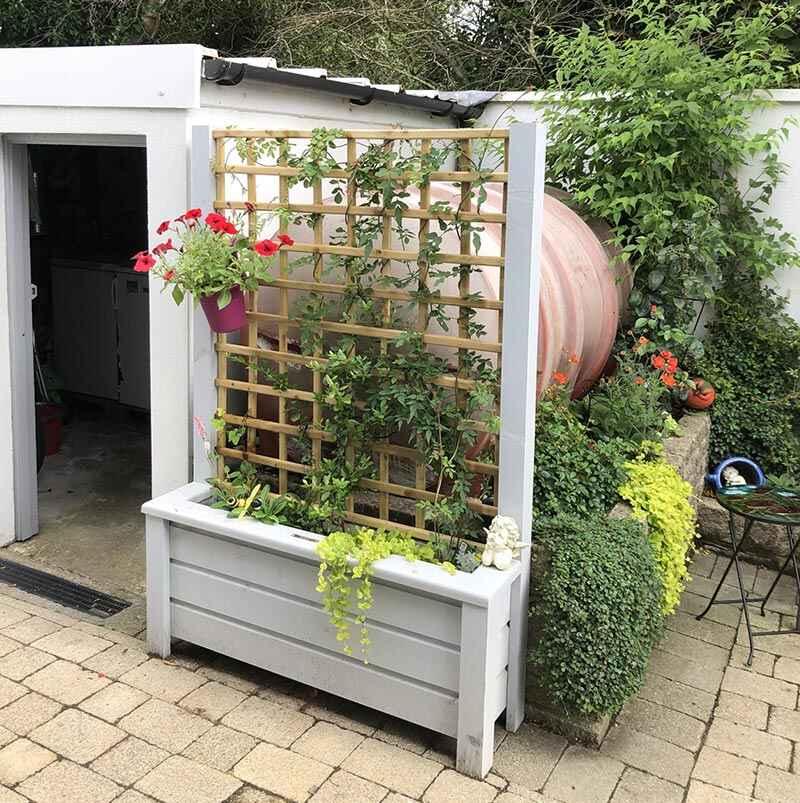
Not every climbing rose needs to be attached to a wall or fence. A freestanding trellis lets you grow one in the middle or back of a flower bed.
This solves the problem of having the perfect sunny planting spot but nothing nearby to attach the rose to.
Choose a sturdy rectangular trellis fixed between two posts, or build your own using treated timber. The support should be tall enough to suit the rose but still reachable when you need to tie or prune it.
Position it behind shorter flowers so the rose becomes a backdrop rather than blocking everything else.
A freestanding support can also hide practical areas such as bins, compost bays or the side of a shed when you cannot attach anything directly to them.
Avoid lightweight trellises that are simply pushed a few inches into the soil. Once the rose becomes established, wind and wet foliage can pull an unstable support over.
15. Grow a Rose Up an Obelisk in a Small Garden
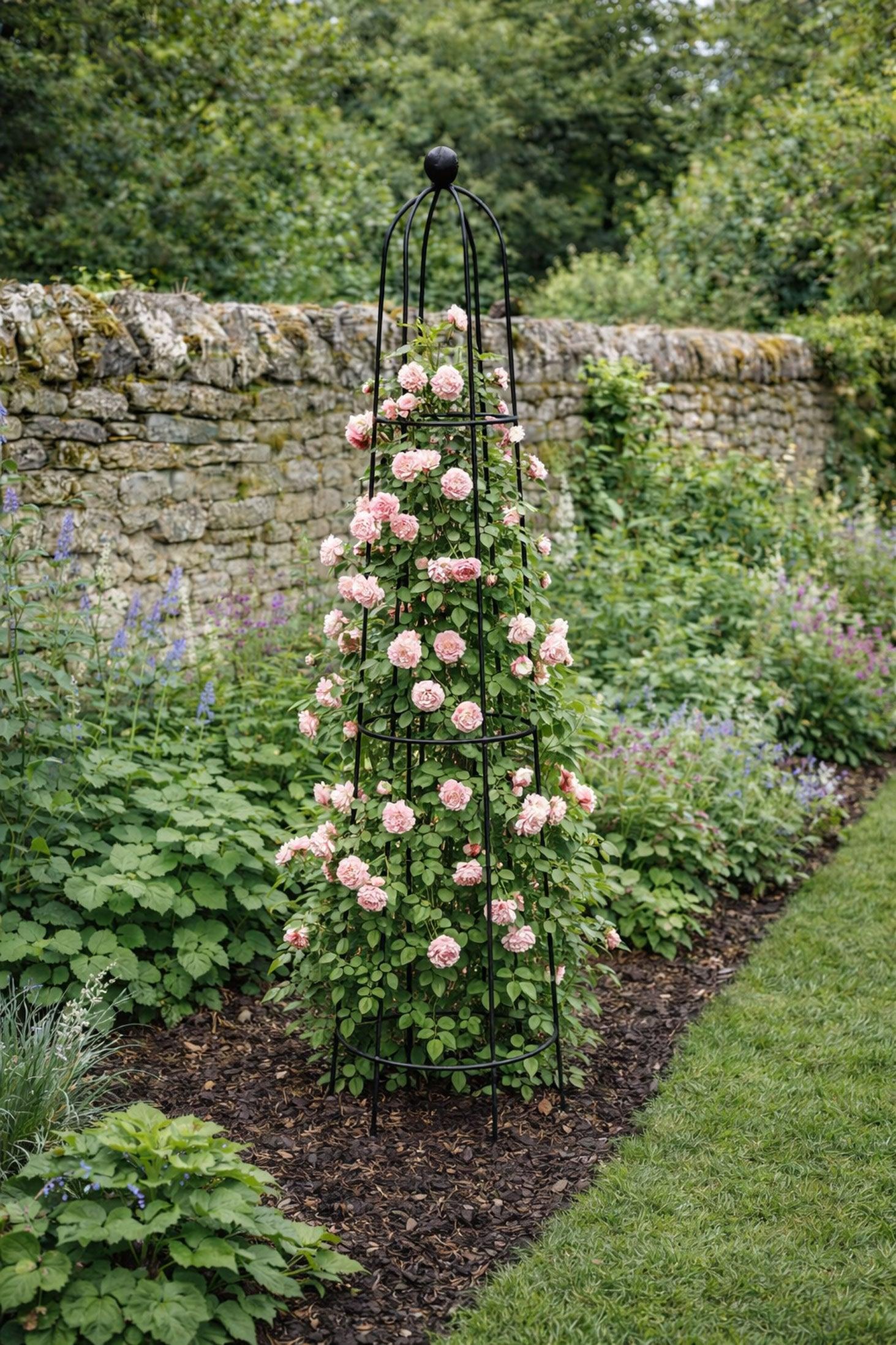
An obelisk is useful when you want to grow upward without taking up much space along a wall or fence.
It works particularly well in a small flower bed, cottage garden or awkward corner where a wide trellis panel would not fit.
Place a tall, sturdy obelisk over or just behind the rose and begin tying young stems around the outside. Do not wrap the canes tightly around the structure. Give them gentle curves and several secure ties so you can still remove or reposition stems later.
Metal obelisks are easy to buy, but you can also make a simple wooden version from four uprights joined at the top with horizontal supports between them.
This is a good option for smaller climbing roses or roses that can be kept under control with pruning.
Put it somewhere you can reach from all sides because pruning becomes difficult if the structure is pushed tightly into a hedge or fence corner.
16. Grow Climbing Roses in Pots With a Trellis
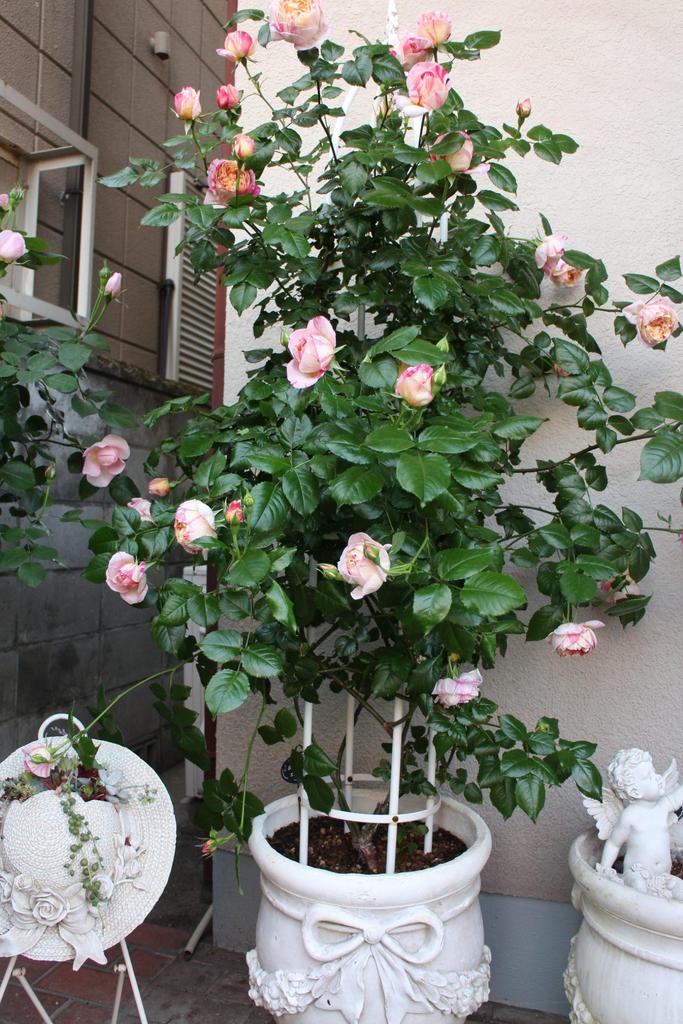
You do not need a large flower bed to enjoy a climbing rose. Climbing roses in pots can work on patios, balconies and small paved gardens when the container and support are large enough.
Choose a substantial pot rather than a small decorative planter because climbing roses need room for their roots and can become top-heavy.
You can place a freestanding trellis behind the container, use a pot with an attached trellis or position the container beside a wall-mounted wire support.
For climbing roses in pots trellis setups, stability is especially important. A tall rose can act like a sail in strong wind, so a lightweight trellis pushed only into potting compost may tip over.
Place the container against a sunny wall or beside a patio where the plant can grow vertically without taking up much floor space.
This is one of the most practical options for renters or homeowners who have paving instead of traditional garden beds.
17. Use a Narrow Vertical Trellis in a Small Garden
A tall, narrow trellis lets you grow plenty of rose stems without sacrificing much ground space.
This is useful in side yards, narrow beds, small patios and compact back gardens where a wide bush would quickly take over the available space.
Choose a slim wall trellis, wire system or narrow freestanding panel and train the main rose canes upward and slightly outward.
You can also place several narrow panels beside each other along a boundary rather than using one very wide trellis.
For a cheap version, run strong horizontal wire between two vertical posts. This keeps the support narrow while still giving you enough places to tie the stems.
Small-space trellises work particularly well behind a bench, beside a shed, along a narrow passage or against the rear boundary of a small garden.
The main thing to avoid is choosing a rose that will become much larger than the space available.
18. Build a Heavy-Duty Trellis for a Mature Climbing Rose
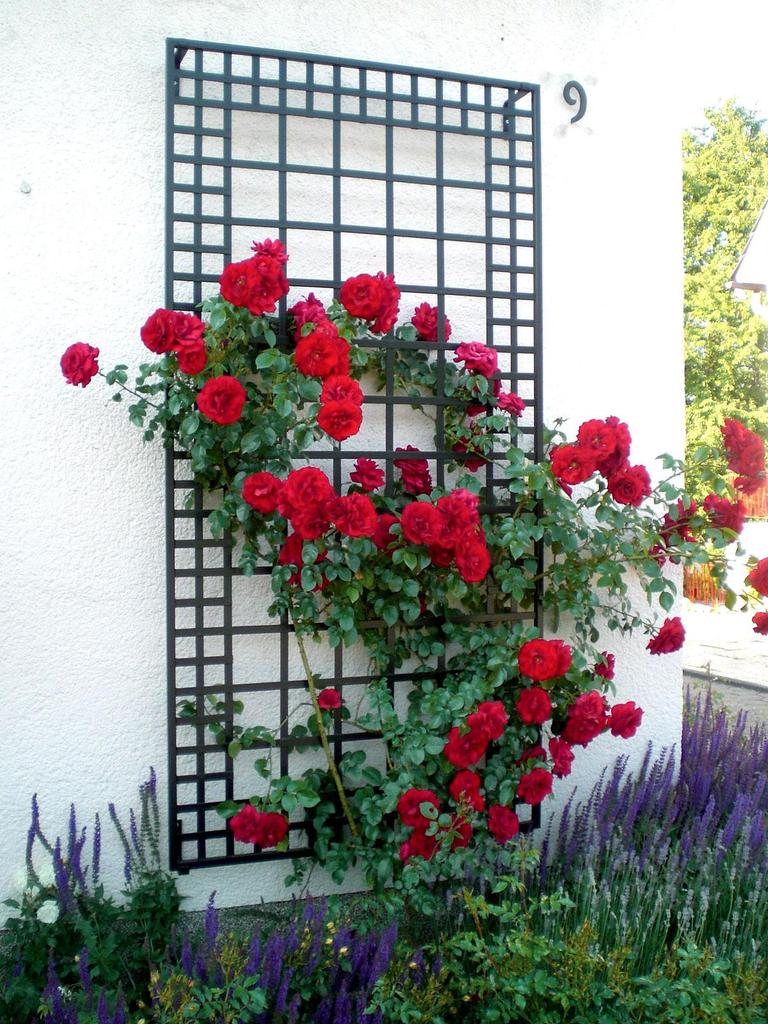
A pretty trellis is no use if it starts leaning as soon as the rose reaches full size.
Mature climbing roses can carry a surprising amount of weight, especially when the plant is covered in flowers or wet after rain. If you already have a vigorous rose, choose strength before decoration.
Use thick timber posts, securely mounted metal panels or strong tensioned wire fixed into appropriate supports. If the rose is growing against a fence, do not assume thin fence boards can hold the entire plant.
Spread the main canes across several support points so the weight is not concentrated in one small area. Replace weak ties with soft but durable plant ties and check fixings each year before the main flowering season.
This is particularly important for large roses growing over pergolas, arches, house walls and long fences.
If you are planting a new climbing rose, building a stronger trellis at the beginning is usually much easier than replacing an undersized one later.