








A conventional backyard pool often feels artificial, bright blue water, chemical smell, constant maintenance. So you might be here wondering how to build a natural pool.
Think of creating a natural pool like creating a small freshwater ecosystem designed specifically for people. Plants filter water, bacteria break down nutrients, and circulation keeps everything oxygenated.
If you’ve ever wondered how to build a natural pool in your yard, the process is more structured than it appears. It blends landscaping, excavation, ecology, and simple plumbing. With careful planning and the right balance, you can create a self-cleaning swimming environment that lasts decades.
What Is a Natural Pool and Why Homeowners Love It
Natural pool vs traditional swimming pool
A traditional swimming pool is essentially sterile water contained in concrete or fiberglass, kept clean through chlorine or salt chlorination. Filtration is mechanical and chemical. Water is biologically inactive by design.
A natural pool is the opposite philosophy. Instead of sterilizing water, it maintains biological balance. Water passes through planted zones where microorganisms consume nutrients that would otherwise feed algae. Because algae lack nutrients, water stays clear naturally.
So the difference is not just materials, it’s ecological function. One is chemically controlled. The other is biologically stabilized.
Benefits for environment and lifestyle
Natural pools appeal to people seeking a more organic outdoor environment. The water has no chemical smell, no eye irritation, and no bleaching effect on swimwear. Many swimmers say the water feels silkier because it lacks dissolved chlorine.
There are also practical benefits. Chemical costs disappear. Harsh pool equipment like backwash filters are unnecessary. The pool becomes visually attractive year-round, even when not in use, because it resembles a pond or water garden rather than an empty basin.
Emotionally, natural pools often feel calmer. The presence of plants, stone edges, and wildlife creates a more relaxed atmosphere than typical pool design.
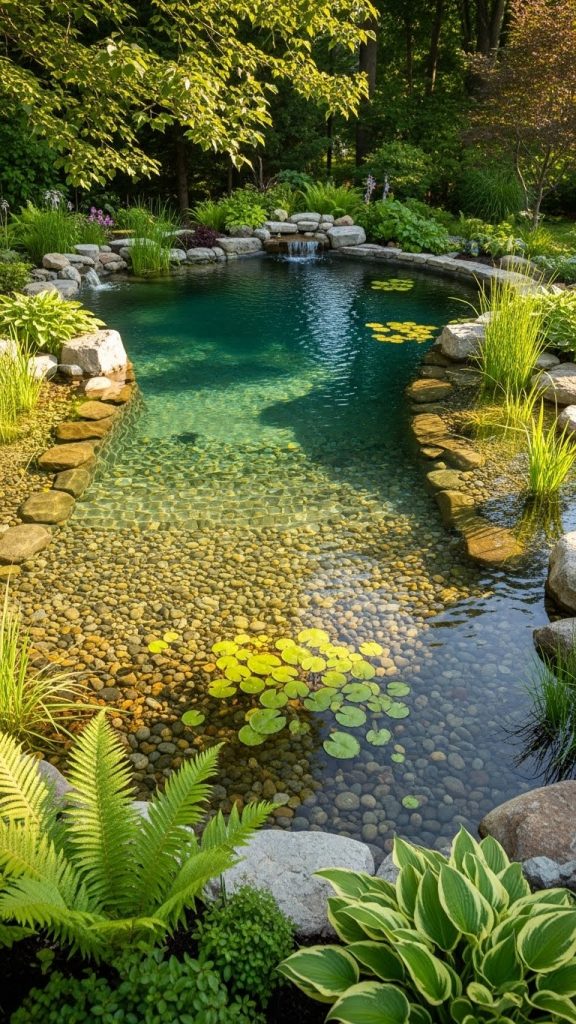
Planning Your Natural Pool Project
Assessing yard size and location
A natural pool requires thoughtful spatial planning. Because filtration occurs in plant zones, you need sufficient area for regeneration.
In most designs, total pool footprint is larger than a chemical pool of equal swimming area.
A common guideline is at least 50 square meters total surface area for a comfortable natural pool.
Smaller versions exist but require advanced filtration systems.
When assessing your yard, visualize circulation paths, seating areas, and views from windows.
The pool should feel integrated, not squeezed in.
Understanding sunlight, drainage, and soil
Sunlight drives plant growth but also algae growth. Moderate exposure, roughly half-day sun, creates optimal balance. Constant full sun increases nutrient demand and raises water temperature. Deep shade weakens plant filtration capacity.
Drainage matters because runoff carries soil nutrients into water. Even small fertilizer traces can trigger algae blooms. The pool should sit slightly elevated or protected from garden runoff using edging or grading.
Soil composition affects excavation stability. Clay soils hold shape well. Sandy soils collapse easily and need retaining structures or compacted bases. Testing soil before digging prevents surprises.
Local regulations and permits
Many jurisdictions classify natural pools legally as swimming pools, regardless of chemical use.
That means safety fencing, setbacks from property lines, and depth regulations may apply.
Some regions also regulate water bodies larger than a certain volume.
Before excavation, confirm building codes, electrical requirements for pumps, and child safety rules.
It’s easier to design within regulations than modify later.
Natural Pool Design Fundamentals
Swimming zone vs regeneration zone
The regeneration zone is the biological heart of the pool.
Water flows slowly through gravel and plant roots where bacteria convert dissolved nutrients into biomass.
Plants absorb these nutrients to grow, removing them permanently from the water column.
The swimming zone remains open and plant-free for clarity and usability.
A physical separation, often underwater walls or shelves, prevents gravel migration and maintains visual distinction.
Modern designs sometimes reduce plant area to 30 percent using advanced filters, but ecological balance still requires sufficient biological surface area.
Shapes and aesthetics
Organic shapes mimic natural ponds and blend seamlessly with gardens.
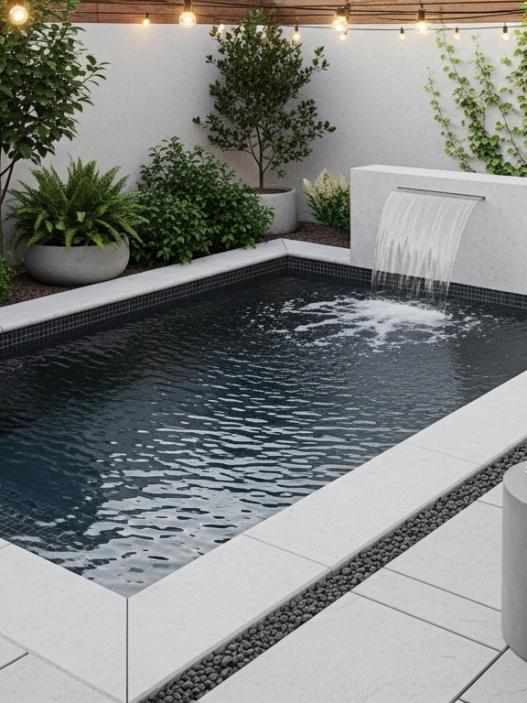
Curves soften edges and allow varied planting shelves. However, geometric natural pools are increasingly popular in contemporary landscapes.
Straight lines with planted margins create a clean, architectural look.
The key principle is coherence with surroundings. A rustic garden suits irregular shapes.
A modern terrace suits rectilinear forms. The water surface becomes a design element like lawn or paving.
Depth considerations
Depth affects temperature stability and algae risk. Deeper water stays cooler and more stable, limiting algae growth.
Very shallow swimming areas heat quickly and promote biological imbalance.
Most natural pools include:
- Shallow plant shelves 20–40 cm
- Entry shelves 60–90 cm
- Swimming depth 1.5–2.5 m
Gradual transitions improve safety and aesthetics while supporting varied plant species.
Choosing the Right Location
Sun exposure requirements
Positioning the pool to receive morning and midday sun supports plant metabolism without overheating.
Afternoon shade from buildings or trees can moderate temperature.
Avoid constant full sun areas such as open lawns with no shelter.
Wind protection
Wind increases evaporation, cools water, and blows debris into the pool.
Sheltered locations reduce maintenance and stabilize temperature.
Natural windbreaks like hedges, fences, or terrain contours are ideal.
Integration with landscape
A natural pool should feel like part of the garden composition. Align edges with planting beds, terraces, or pathways.
Use materials consistent with existing hardscape.
This visual continuity makes the pool appear intentional rather than added later.
Essential Components of a Natural Pool
Liner systems
Flexible liners allow custom shapes and long service life. EPDM rubber is widely used due to durability and UV resistance.
Thickness typically ranges from 1.0 to 1.5 mm. Reinforced PVC liners offer similar function with different handling properties.
Underlayment fabric beneath the liner protects against punctures from stones, roots, or soil movement.
Multiple layers may be used on steep walls.
Filtration and circulation
Water circulation drives the entire ecosystem. Pumps move water from the swimming zone through regeneration zones or biofilters and back.
Turnover rates typically aim for complete circulation every 4 to 6 hours.
Slow laminar flow through plant gravel beds maximizes nutrient uptake.
Rapid turbulent flow is avoided in biological zones.
Aquatic plants and substrates
Substrate layers create filtration surfaces. Coarse gravel supports structure and flow.
Fine gravel supports root anchoring. Microorganisms colonize these surfaces, forming biofilms that digest dissolved nutrients.
Plants absorb nitrogen and phosphorus while providing oxygen to root zones.
Together substrate and plants function as a living filter.
Step-by-Step: How To Build a Natural Pool
Step 1: Mark and excavate the pool area
Accurate marking ensures correct proportions.
Separate zones visually during marking to maintain design ratios. Excavation should create smooth contours, avoiding sharp corners that stress liners.
Base compaction stabilizes soil. Remove roots, stones, and debris. Shape shelves precisely for plant zones.
Step 2: Install base and underlayment
A cushioning layer, often sand or fine soil, prevents liner abrasion. Geotextile fabric covers all surfaces continuously.
Overlap seams generously to avoid gaps. Walls require careful smoothing to avoid pressure points.
Step 3: Place liner and structure
Liner placement works best in warm weather when material is flexible.
Spread evenly without tension.
Anchor edges in perimeter trenches or beneath coping stones.
Partial filling helps seat the liner into contours.
Step 4: Create regeneration zone
Install retaining walls or partitions separating swimming and plant zones.
Add graded gravel layers, coarse below, finer above.
Ensure water pathways allow gentle flow through the substrate.
Step 5: Install pump and circulation
Place intake points in swimming areas and return outlets in regeneration zones or vice versa depending on design.
Conceal plumbing beneath gravel or edging. Pumps should be energy-efficient and sized for volume turnover.
Step 6: Add plants and fill water
Plant species according to depth zones.
Fill slowly to prevent substrate disturbance. Start circulation once full.
Initial water may appear cloudy but clears as biological balance establishes over weeks.
Best Plants for Natural Pool Filtration
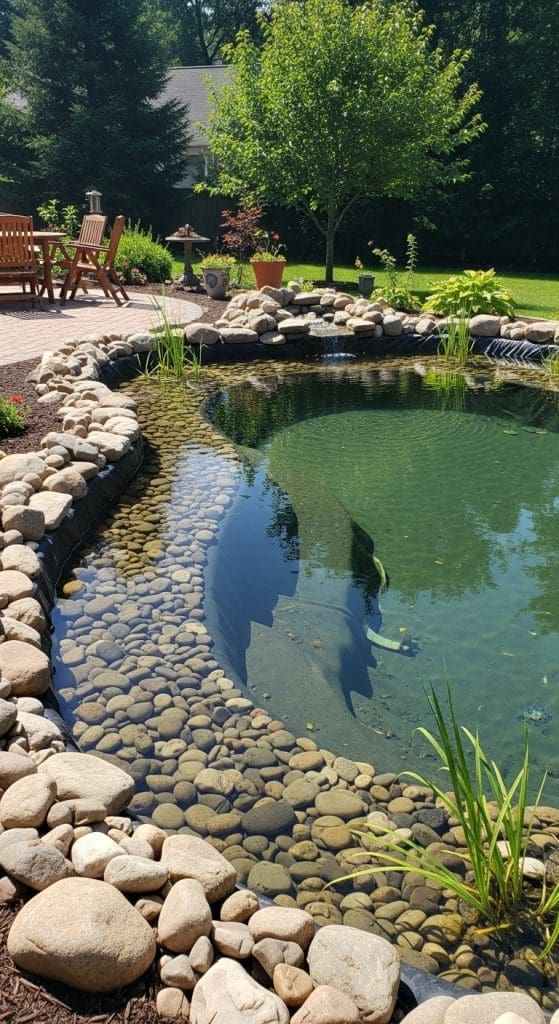
Oxygenating plants
Submerged plants release oxygen into water and absorb dissolved nutrients directly.
They maintain microbial health and clarity.
Species like hornwort and elodea grow rapidly and stabilize water chemistry.
Marginal plants
These occupy shallow shelves and form dense root networks in gravel.
Their roots host beneficial bacteria that process nutrients. Iris, rushes, and sedges provide structural filtration and visual interest.
Floating plants
Floating leaves shade water, reducing light penetration that fuels algae.
Water lilies also create habitat complexity and aesthetic beauty.
Surface coverage of 30 to 50 percent is typical for algae control.
Filtration Systems Explained
Biological filtration
Biofilms on gravel and roots convert ammonia into nitrate and ultimately into plant biomass.
This nitrogen cycle removes waste nutrients from water. Without nutrient accumulation, algae cannot dominate.
Mechanical filtration
Skimmers remove leaves and debris before decomposition releases nutrients.
Some designs include fine filters or settling chambers to trap suspended particles.
Mechanical removal complements biological filtration.
Pump selection
Pump capacity depends on pool volume.
For example, a 50,000-liter pool typically uses a pump delivering 10,000–12,000 liters per hour.
Energy efficiency matters because pumps run continuously. Low-wattage pond pumps are standard.
Natural Pool Maintenance Tips
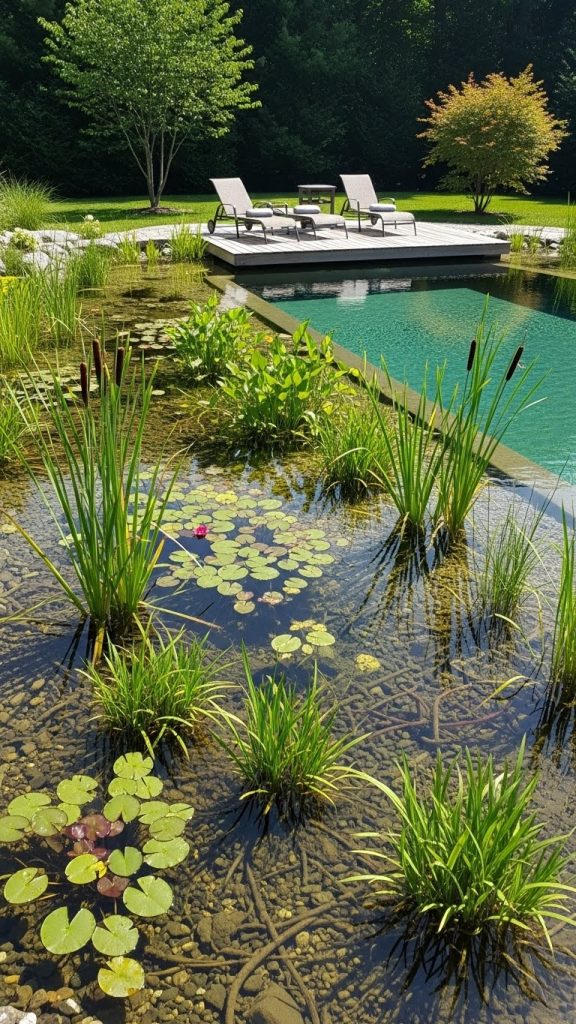
Seasonal care
Spring involves trimming dead plant material and restarting circulation.
Summer maintenance is mostly skimming debris and checking pump function.
Autumn leaf nets prevent organic buildup.
Winter requires minimal intervention unless freezing occurs.
Algae prevention
Algae appears when nutrients exceed plant uptake.
Prevent runoff, avoid fertilizer near the pool, and maintain plant density.
Proper depth and shading also reduce algae risk.
Water clarity management
During the first season, water may fluctuate as ecology stabilizes. Temporary turbidity is normal.
Fine filtration media or flocculants can help early stages but become unnecessary once balance forms.
Cost of Building a Natural Pool
DIY vs professional installation
DIY construction reduces labor cost significantly but requires planning accuracy.
Professional builders bring ecological expertise and structural assurance.
Costs vary widely by size and materials.
Materials cost breakdown
Major expenses include excavation equipment, liner, pump system, gravel substrate, and plants.
Compared to concrete pools, structural materials are often lower cost, though excavation area may be larger.
Long-term savings
Natural pools eliminate chemical purchases and reduce energy use from filtration systems.
Maintenance equipment replacement is minimal.
Over decades, lifetime cost can be substantially lower than conventional pools.
Common Mistakes to Avoid
Poor plant balance
Too few plants cannot absorb nutrients effectively.
Too many reduce swimming usability.
Maintaining appropriate plant density relative to water volume is essential.
Incorrect depth
Shallow pools warm quickly and destabilize biologically.
Proper depth maintains temperature stability and supports ecological equilibrium.
Insufficient circulation
Dead zones with stagnant water allow nutrient accumulation.
Continuous circulation ensures oxygen distribution and filtration efficiency.
Safety Considerations
Child safety
Fencing or covers may be legally required.
Gradual slopes and clear edges improve visibility and access.
Natural pools can be as safe as traditional pools with proper design.
Edges and entry points
Stable stone steps or wooden platforms provide secure entry. Avoid slippery vertical walls.
Textured surfaces improve traction.
Water quality monitoring
Although natural pools are biologically filtered, occasional testing ensures healthy parameters.
Clear water, balanced plant growth, and absence of odor indicate proper function.
Enhancing Your Natural Pool Area
Decking and seating
Wood decks or stone terraces provide lounging areas and reduce soil entry into water.
Elevated decks also frame views and improve accessibility.
Lighting
Subtle underwater lights create evening ambiance. Warm perimeter lighting highlights water movement and plants.
Avoid excessive brightness to preserve natural feel.
Landscaping
Native grasses, perennials, and shrubs around the pool strengthen ecological integration.
Naturalistic planting blurs boundaries between water and garden.
Is a Natural Pool Right for You
Climate suitability
Temperate climates support plant filtration easily. Cold climates may require winterization.
Very hot climates need shading and circulation adjustments.
Lifestyle factors
Natural pools suit homeowners who appreciate ecological aesthetics and gentle maintenance rather than chemical sterilization.
They reward observation and seasonal interaction.
Space requirements
Adequate area improves filtration stability. Compact designs exist but require careful engineering.
Larger footprints create more resilient ecosystems.
Environmental Benefits of Natural Pools
Chemical-free swimming
No chlorine or algaecides enter soil or groundwater. Surrounding vegetation and wildlife remain unaffected. Human exposure to chemicals disappears.
Biodiversity support
Natural pools create micro-habitats for insects, amphibians, and birds. They function as small ecological islands within residential landscapes.
Water conservation
Natural pools do not require backwashing or draining for chemical resets. Water remains stable for years with minimal replenishment.
Building a natural pool in your yard combines landscape design, ecological balance, and practical construction into a uniquely rewarding project.
Instead of maintaining sterile water with chemicals, you create a living system that cleans itself through plants and microorganisms.
The result is more than a swimming space. It becomes a tranquil focal point, a habitat, and a natural retreat woven into your garden.
With thoughtful planning, balanced planting, and steady circulation, a natural pool offers clear water, low maintenance, and a deeply satisfying connection to nature right outside your home.
FAQs
How deep should a natural pool be
Swimming zones typically range from 1.5 to 2.5 meters. Depth stabilizes temperature and limits algae growth while providing comfortable swimming.
Do natural pools attract mosquitoes
Healthy natural pools rarely support mosquitoes because water movement and aquatic predators disrupt their life cycle. Stagnant water is the main risk factor.
Can you swim year-round in a natural pool
In warm climates yes. In cooler regions swimming is seasonal unless heating is added. The ecosystem itself remains functional year-round.
How long does it take to build
DIY construction usually takes several weeks depending on size. Professional builds may take 2 to 4 weeks. Biological stabilization develops over the first few months.
Are natural pools hard to maintain
Maintenance is generally lighter than chemical pools. It focuses on plant care, debris removal, and circulation monitoring rather than chemical balancing.